
Introduction to Steer-by-Wire System
Steer-By-Wire, that is, Steer-By-Wire, can unrestrictedly obtain the relationship between the target input of the unmanned driving's turning instructions and the changes of the car's steering wheels, and can control the relationship between the steering mechanism and driving needs, thereby enabling the adjustment of the vehicle. It directly controls the precise control of the autonomous driving path and direction.
1. Development history of steer-by-wire
Since the installation of the first modern steering system with a steering wheel in passenger cars in 1894, the steering system has roughly gone through 5 stages:Early purely mechanical steering systems;The hydraulic power steering system first proposed by Ford;The electro-hydraulic power steering system first introduced by Toyota;The new generation of electric power steering systems;Steer-by-wire systems that get rid of mechanical connections, and front-wheel active steering systems with active steering functions, etc.
Electro-Hydraulic Power Steering (EHPS)
The driver applies a turning torque and angle to the steering wheel; the steering wheel drives the steering column to rotate; the steering column, through the rack-and-pinion mechanism connected to the steering gear at its bottom, converts the rotation of the steering column into the lateral linear movement of the steering gear's rack; the steering torque sensor detects that the driver has input steering wheel torque; based on the torque input by the driver and information such as vehicle speed, the ECU calculates and controls the electric motor to drive the steering power pump to rotate, generating high-pressure fluid; the hydraulic pressure is transmitted to the hydraulic power steering gear through the steering oil pipe, and the hydraulic pressure pushes the piston of the double-acting hydraulic cylinder on the hydraulic power steering gear, generating pressure to assist the lateral linear movement of the rack; the tie rods at both ends of the steering gear change the direction of the wheels by pushing or pulling the steering knuckles;A lateral force is generated between the wheels and the ground, and the vehicle turns.
1.2. Electric Power Steering (EPS)
The first type provides power assistance to the torque of the steering column, which is called C-EPS (Column-EPS); the second type provides power assistance to the gear in the rack-and-pinion mechanism at the bottom end of the steering column, which is called P-EPS (Pinion-EPS); the third type provides power assistance to the linear movement of the rack on the steering gear, which is called R-EPS (Rack-EPS); and R-EPS can be further divided into R-EPS, DP-EPS (Dual Pinion EPS) and BD-EPS (Belt Drive EPS) according to different transmission methods.
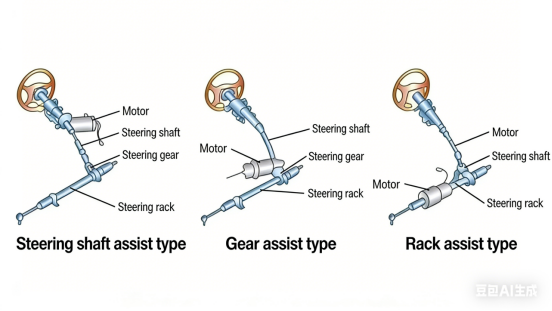
1.3. Steer-by-Wire (SBW)
In a narrow sense, the SBW system specifically refers to a steering system without mechanical connections, which is a distinction made based on the structure of the system. However, from a functional perspective, in a broad sense, any steering system that can decouple the driver's input from the front wheel angle can be regarded as an SBW system. Under this definition,The general structure is as shown in the figure below。
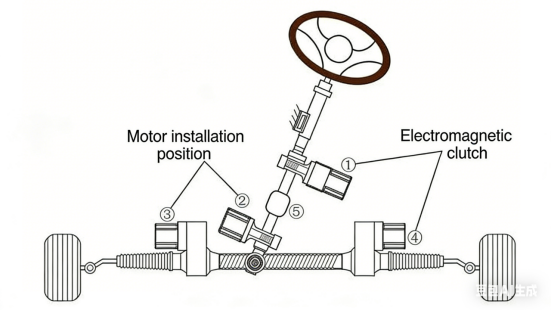
Among them, ① - ④ are the possible installation positions of the motor, and ⑤ is the electromagnetic clutch. The electromagnetic clutch provides mechanical redundancy and can realize the mechanical decoupling between the steering wheel and the wheels. According to the presence or absence of ⑤, SBW systems can be divided into two categories: SBW systems with retained mechanical soft connections and SBW systems without mechanical connections. Therefore, people have studied dual-motor safety redundant steer-by-wire systems. This scheme includes a steering control mechanism, a steering execution mechanism, an electronic by-wire control network, a power supply system, and various auxiliary structures. This scheme closely combines traditional mechanical steering with electronic control technology. The two modes of by-wire active steering and mechanical steering can be switched arbitrarily through the electromagnetic clutch. Moreover, through fault identification, mechanical steering can serve as a backup for by-wire active steering, improving safety.
Currently, research on steer-by-wire systems mainly focuses on three aspects: research on road feel feedback control strategies, research on steering execution control strategies, and research on fault diagnosis and fault-tolerant control strategies.
Since the steer-by-wire system eliminates the mechanical connection between the steering wheel and the steered wheels, and controls the wheel steering through steering angle signals and steering motors, the road feel cannot be directly fed back to the driver, which is absolutely not allowed from the perspective of driving safety.
To address this issue, the steering wheel assembly of the steer-by-wire system includes a road feel simulation motor, which is used to generate a resistance torque acting on the steering wheel to simulate the road feel. Road feel is a relatively abstract concept; one of its definitions refers to the steering resistance torque that the driver obtains through the steering wheel during vehicle driving. This resistance torque mainly consists of two parts: the aligning torque and the friction torque. Among them, the aligning torque is one of the main torques that make the wheels return to the straight-line driving position. Determining its value is a difficult problem in vehicle design, and it is usually obtained through empirical, semi-empirical, statistical, or experimental methods. The aligning torque is directly related to the force state of the vehicle's front wheels, and the front wheel force is directly related to the real-time motion state of the vehicle and road surface adhesion. Therefore, the steering wheel hand torque, which is usually approximated by dividing the total aligning torque by the total force transmission ratio from the steering wheel to the front wheels, is regarded as the road feel.
In current research, road feel is usually obtained using two methods: experience-based design and model-based design.
The experience-based design method typically designs the road feel as a nonlinear functional relationship of parameters such as steering wheel angle, vehicle speed, and yaw rate, providing different road feels to the driver under different conditions. It is simple and efficient but has poor adaptability and accuracy.
The dynamic model-based method involves establishing relevant dynamic models by referring to the dynamic principles of road feel generation in traditional vehicles. Based on the vehicle's dynamic response, the driver's steering wheel input, etc., it calculates tire forces, friction torques, etc., related to road feel, and finally computes the road feel. Once the desired steering resistance torque is obtained, the remaining work is to control the road feel feedback motor to achieve the desired torque. The most commonly used algorithm is the PID algorithm.
-
- Shifting to Implementation Research
The steering execution control strategy of the SBW system can be divided into upper-layer strategy and lower-layer strategy.
The upper-layer strategy calculates the desired front wheel angle based on the current vehicle state and driver input, while trying to meet the control objectives and constraints; the lower-layer strategy is that the steering controller controls the steering motor to execute the instruction, so as to quickly and accurately reach the target angle.
Due to the flexibility of the steer-by-wire system, many control algorithms have been derived. In general, the algorithms can be summarized into two categories: methods based on empirical design and methods based on dynamic model calculation.
The method based on empirical design is mainly designed according to the different requirements of vehicle handling and stability under different working conditions. Under low-speed conditions, the car should have a moderate steering wheel force that is not heavy, a steering wheel angle that is not too large, and good return performance; under high-speed and low lateral acceleration conditions, the car should have good yaw rate frequency characteristics, straight-line driving ability, return performance and high steering sensitivity, and the steering wheel force should not be too small but should be maintained at a certain value to give the driver a stable road feel.
The method based on dynamic model calculation aims to improve the stability of the vehicle. Therefore, some researchers also classify this method as a vehicle stability control method. Its basic idea is to propose control objectives according to the current vehicle state, external environment and driver input, then calculate the reference front wheel angle according to the control objectives, control the front wheel angle to change the tire lateral force, and compensate the yaw moment.
2.3. Fault Diagnosis and Fault-Tolerant Control
In steer-by-wire, the power for steering comes from the motor, which mainly includes two aspects: providing the driver with road feel and power during steering. The reliability of the motor is the first factor that researchers need to consider, and the fault tolerance of the motor and controller is very important. Real-time monitoring technology and setting redundant hardware are two means to ensure the stable operation of the controller, so fault-tolerant control can be realized, and the operation quality of steer-by-wire is guaranteed. According to the control relationship between the controller and the motor, relevant research can be carried out on the compensation control required when the motor fails, which provides the possibility to ensure the reliability of steer-by-wire to the greatest extent.
3.3. Application of Steer-by-Wire
From the perspective of the global competitive landscape, international giants such as Bosch, ZF, JTEKT, NSK, and Nexteer have mature steer-by-wire products and technologies, but they still encounter bottlenecks in commercialization.
After 2020, the mass production of L3-level autonomous driving will drive the commercialization of steer-by-wire system products, and those foreign-funded enterprises that take the lead in deploying in the Chinese market will have first-mover advantages. Looking at the domestic market, there are very few Chinese local enterprises that have made achievements in steer-by-wire technology, and their scales are relatively small.
Disclaimer: This article is shared only to disseminate knowledge related to automobile chassis. Its copyright belongs to the original author. Thanks to the original author for their hard work; if there are any infringement objections, please contact us for negotiation or deletion. Thank you!
FUCHI's Analysis of the Hilux/Fortress Steering Gear Assembly 44200-0K770 for Toyota's steering gear/steering assembly/hydraulic steering rack assembly.
The working principle of the automobile steering gear
Related Article
